 Skip to content

Betting
On the raceday market itself, there are consistent patterns. Ante-post markets on the Cheltenham Gold Cup or Champion Hurdle typically run between 140 and 160 per cent, which is lower than the National but still significantly wider than raceday. The aggregate effect across 20 runners adds up to a much wider margin than in a six-runner race.
Using the exchange as a benchmark — even if you ultimately bet with a bookmaker — is one of the most effective habits a punter can develop. If the exchange offers 7.0 and the bookmaker offers 5/1, the bookmaker is taking a significantly larger margin on that runner, and you should either back on the exchange or find a bookmaker whose price is closer to the exchange level. If the exchange offers 6.0 and the bookmaker offers 5/1, the bookmaker is competitive after commission. The practical approach for most punters is to use both. When should you use the exchange, and when should you use a bookmaker? The commission you pay on an exchange winning bet reduces your effective odds.
This is the overround, and it is the first hurdle any punter must clear to profit long-term. In today’s day and age where automobiles have substituted the four legged animal, horses still retain importance. After landing two winners from three selections in his previous Champions League preview, Andy Schooler returns with three more best If the enhanced price represents genuine value (and it often does, particularly on shorter-priced selections where the boost is meaningful), use it. Second, the exchange price reflects pure market opinion without any built-in margin, which makes it a more accurate indicator of the horse’s implied probability.
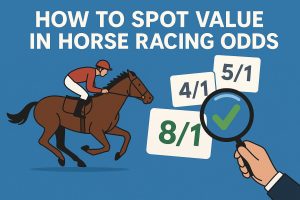
The difference between 5/1 and 6/1 on the same horse in the same race is a 20 per cent increase in profit — free money, essentially, for the 30 seconds it takes to check a second bookmaker. Each-way is unprofitable on short-priced horses where place returns are minimal, in small fields with weak terms, and when your assessment favours win-or-nothing outcomes. BOG value emerges when horses attract late support and steam into shorter prices, while your early-morning selection drifts in consequence. Always check the specific terms at your chosen bookmaker before calculating whether each-way represents value. For punters betting on the morning’s early races or taking ante-post positions that settle on the day, checking the activation window is essential. The punter who understands odds mechanics and monitors these differences consistently captures value; the one who does not subsidises bookmaker profits.
At the lower end, you find small-field Flat races — Group 1 contests with five or six runners where the form is well established and bookmakers compete aggressively on the headline price of the favourite. Across UK and Irish horse racing, typical bookmaker overrounds range from about 110 to 130 per cent. It varies by operator, by race type, and by the time of day. The margin a bookmaker builds into horse racing odds is not fixed. Small-field races with well-fancied favourites tend to carry lower overrounds (closer to 110 per cent) because the market is more efficient and bookmakers compete harder on the headline price of the favourite. The overround also tells you something about the race itself.
Extra places promotions warrant particular attention during major festivals and feature race days. At 1/4 odds, the same selection returns 5/2 (plus stake) for placing. If your selections consistently close shorter than the price you took, your assessment method is adding value. The days when betting shops competed fiercely on price have given way to an era where online bookies platforms sometimes offer “good enough” pricing, knowing many customers will not check elsewhere. Before placing multiple bets, check the specific bookmaker’s terms—assuming BOG applies universally is a common and costly mistake. BOG is a tool for capturing extra edge when your original selection was sound; it does not substitute for sound selection.
At decimal odds of 6.00, a £10 bet returns £60 total—your £10 stake plus £50 profit. The first number represents potential profit; the second represents the stake required to generate that profit. At 7/2, the same £1 stake returns £3.50 profit plus stake, totalling £4.50.
These are standard industry terms, but bookmakers frequently enhance them for major races or as ongoing promotions. If prices consistently drift after you bet, something in your analysis may need adjustment. Value exists in the gap between your probability assessment and the bookmaker’s implied probability. A horse at 2/1 (33% implied probability) that you assess as a 25% chance is not—even though the shorter price might feel safer. A horse at 4/1 (20% implied probability) that you assess as a 25% chance is a value bet. The more fundamental question is whether those odds represent value—whether the implied probability understates the horse’s true chance of winning.


